Evidence
LP backtest: TORQUE's vault over 90 days of real NVDA prices
Generated by research/lp_backtest.py on 2026-10-03. Prices: every Chainlink RHNVDA/USD print on Robinhood Chain from 2026-07-06 to 2026-10-02 (979 prints, 88.7 days), the feed TORQUE reads. Knock-outs can only fire at a fresh print, so this is the path the contract would have acted on, weekend gaps included.
Demand is assumed, not measured. Traders borrow every dollar the vault may lend, reopen as soon as a position ends, and close after a holding period. That is the best case for LP income and the most LP money at risk. Lower demand scales income down roughly in proportion (see the 40% rows).
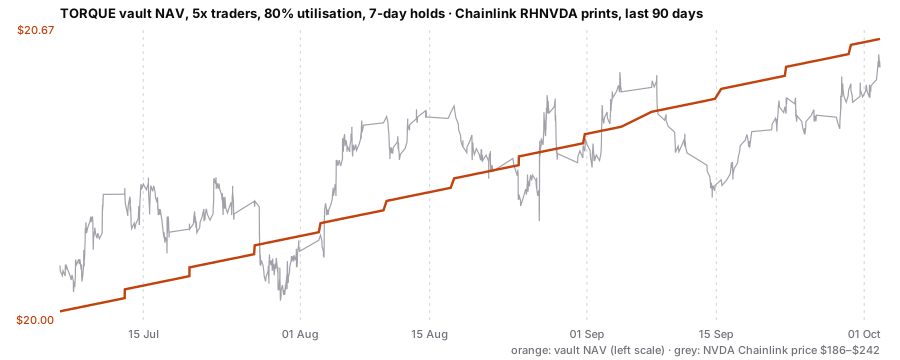
Result: 5x traders, 80% utilisation, 7-day holds
| Measure | Result |
|---|---|
| LP return over the window | +3.25% (14.1% a year) |
| Of which | $0.375 interest at 10% APR, $0.261 open fees, on a $20 vault |
| Knock-outs | 0 |
| Bad debt (LP loss) | $0.00 |
| Worst drawdown of vault NAV | 0.00% |
| Worst day for vault NAV | +0.014% (2026-09-17) |
| Mean utilisation | 78.9% |
The worst case, as plainly as the average
These 89 days never tested the floor. NVDA rose from $196.29 to $235.00. Its worst fall was -11.3% in seven days (2026-07-22 to 2026-07-29). A 5x position is knocked out at -16% and the LP only loses if one gap goes past -20%. The worst move between two consecutive prints was -1.41%. The feed went quiet for over 12 hours 26 times, so opens would have paused: 12 weekends or holidays (longest 78 h, Fri 04 Sep to Tue 08 Sep) and 14 quiet weekday stretches when NVDA moved too little to trigger a print (longest 21 h). The biggest price move across any silence was -1.12%.
So the zero losses above are this window's, not a guarantee. What matters to an LP is a single gap straight through a position's knock-out level, with no print in between. This table shows the LP loss per $1 lent to a fresh position when that happens (sale 0.2% below the print):
| Leverage | Knocked out at | Worth zero at | Gap -10% | Gap -15% | Gap -20% | Gap -25% | Gap -30% | Gap -40% |
|---|---|---|---|---|---|---|---|---|
| 2x | -48% | -50% | none | none | none | none | none | none |
| 3x | -30% | -33% | none | none | none | none | none | 10.2¢ |
| 4x | -21% | -25% | none | none | none | 0.2¢ | 6.9¢ | 20.2¢ |
| 5x | -16% | -20% | none | none | 0.2¢ | 6.4¢ | 12.7¢ | 25.1¢ |
At 80% utilisation with every loan at 5x, a single gap of -25% would cost the vault 5.1% of its assets, -30% would cost 10.1% and -40% would cost 20.1%. For scale: NVDA's worst day in recent years was a fall of about 17% (27 January 2025). At 5x that knocks positions out and costs the LP nothing; it takes a gap beyond about 20% to reach LP money.
Across leverage, utilisation and holding time
| Leverage | Utilisation target | Hold | LP return | A year | Knock-outs | Bad debt | Mean utilisation | Days a cap refused an open |
|---|---|---|---|---|---|---|---|---|
| 2x | 40% | 7 d | +2.01% | 8.6% | 0 | $0.00 | 39.7% | 0 |
| 2x | 40% | 30 d | +1.21% | 5.1% | 0 | $0.00 | 39.8% | 0 |
| 2x | 80% | 7 d | +3.52% | 15.3% | 0 | $0.00 | 68.9% | 64 |
| 2x | 80% | 30 d | +2.12% | 9.0% | 0 | $0.00 | 69.3% | 64 |
| 3x | 40% | 7 d | +1.75% | 7.4% | 0 | $0.00 | 39.7% | 0 |
| 3x | 40% | 30 d | +1.15% | 4.8% | 0 | $0.00 | 39.8% | 0 |
| 3x | 80% | 7 d | +3.51% | 15.2% | 0 | $0.00 | 78.8% | 0 |
| 3x | 80% | 30 d | +2.31% | 9.8% | 0 | $0.00 | 79.2% | 0 |
| 4x | 40% | 7 d | +1.67% | 7.0% | 0 | $0.00 | 39.7% | 0 |
| 4x | 40% | 30 d | +1.13% | 4.7% | 0 | $0.00 | 39.8% | 0 |
| 4x | 80% | 7 d | +3.34% | 14.5% | 0 | $0.00 | 78.9% | 0 |
| 4x | 80% | 30 d | +2.27% | 9.7% | 0 | $0.00 | 79.2% | 0 |
| 5x | 40% | 7 d | +1.63% | 6.9% | 0 | $0.00 | 39.7% | 0 |
| 5x | 40% | 30 d | +1.12% | 4.7% | 0 | $0.00 | 39.8% | 0 |
| 5x | 80% | 7 d | +3.25% | 14.1% | 0 | $0.00 | 78.9% | 0 |
| 5x | 80% | 30 d | +2.25% | 9.6% | 0 | $0.00 | 79.2% | 0 |
When a cap binds
At 2x, the $30 open-interest cap binds before the 80% utilisation limit: a 2x position's notional is twice its loan, so lending $16 would need $32 of open interest. In the 2x / 80% run the cap refused an open on 64 days and utilisation topped out near 69%. From 3x up the 80% utilisation limit is the only constraint, and it binds by construction, because demand is assumed to fill it. The $20 vault cap is the buildathon limit; every figure here is a percentage, so it scales with the vault. The open question is demand, not the cap.
What this does not say
- Demand is assumed (above). Interest is 10% APR on the loan, as the contract charges, and the open fee is 0.10% of notional, paid to the vault.
- Sales into the pool are taken 0.2% below the print. The mainnet-fork sandwich runs filled 0.10-0.17% from Chainlink.
- The pool check (check 2) is not replayed: opens are only tested against check 1, a print in the last 12 hours.
- An owner can close only when the sale covers the debt, as the contract requires; otherwise the position runs until knocked out.
- 24 early rounds (22-23 June, before this window) report a different scale and are excluded; they are listed in
lp-backtest.json.
Re-run it
python3 research/lp_backtest.py             # uses research/data/rhnvda_rounds.csv
python3 research/lp_backtest.py --refresh   # refetches every round from chain (RH_RPC_URL optional)
Outputs: research/lp-backtest.json (every scenario and knock-out event), research/data/lp_backtest_nav_5x_80pct_7d.csv (the NAV series), research/lp-backtest-nav.svg.